

 Italiano
What are you made of?
Our Belpaese is known throughout the world not only for the beauty of its nature and immense artistic heritage, but also for the infinite variety and absolute quality of its food and wine offerings. Italian cuisine has now for many decades become an indispensable reference in the world scene, and our products camp in fine display on the shelves of small and large retailers everywhere.
In this endless proposal of quality, a prominent role is certainly played by the pasta Italian, now recognized as the worthy ambassador of our gastronomic excellence.
On another occasion it will be interesting to recount why it has been so successful, with a knot of stories and legends that do not always clarify the reasons for its unstoppable success; today we want to draw your attention not to pasta in general but to some of the many, many types of pasta that have graced, sometimes for centuries, Italian tables.
Each region of our beloved peninsula has its own traditions, its own peculiar characteristics and thus, invariably also its own typical pasta(s). In telling you a few stories, a few interesting anecdotes, to better understand the origin of even the names, we will not follow a direction that would reasonably take us from north to south of the boot, but we will jump from region to region with the sole desire to stimulate your interest.
On this journey of taste let us begin with a pasta that is very dear to us Tuscans, the Pici.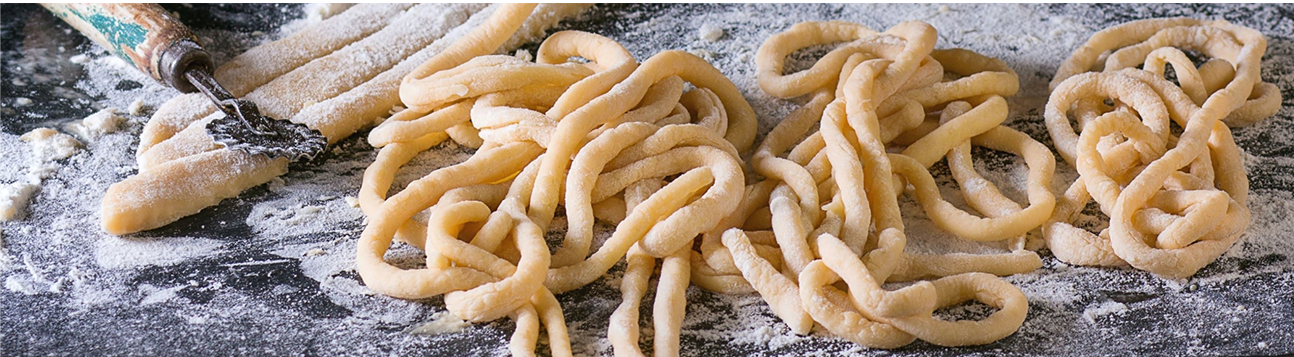
Pici are a type of pasta generally made by hand, similar to spaghetti but wider, typical of southern Tuscany, particularly the Val d’Orcia, Val di Chiana, and Monte Amiata. The ultimate territorial expression: Pici all’Aglione. We have also proposed a revisited recipe Pici all’Aglione. The origin of the name is lost in time and many hypotheses have been formulated regarding its etymology. Some even trace it back to ancient Roman times and the figure of the mythical Apicius, the author in the first century of “De Re Coquinaria.” According to others, the name Pici is linked to the town of San Felice in Pincis, near Castelnuovo. For still others, the name Pici would derive from the verb “to stick,” because of the way they are pulled by hand.
As evidence of their very ancient history, a fresco in the “Tomb of the Leopards” in Tarquinia shows that the Etruscans ate a dish very similar to Pici. A bowl filled with long strands of pasta. Could these have been the ancestors of Pici, of spaghetti? What if the ancient land of origin of our national dish was actually Tuscany? Who knows, we remain with this unresolved question and proceed further.
A couple of hundred kilometers north and we are in Veneto, the land of Bigoli.
The name apparently comes from the dialect term bigàt, which means caterpillar and recalls their elongated shape. The story originates in the time of the Most Serene Republic of Venice, when in 1604 a pasta maker from Padua filed a patent to register a machine of his invention. Mastro Abbondanza, as he was known in his city, was able to produce several types of pasta with his machinery, but one in particular was universally successful, bigoli. Pairing by tradition is with anchovy sauce.
A headlong rush south and we arrive in Sicily, in the province of Trapani, where Busiate welcomes us.
Their shape is that of thin tubes twisted on themselves, and regarding the origin of the name there are two hypotheses in the field: the first argues that this traditional pasta format would be so called because of its similarity to the “buso,” a particular knitting needle commonly used in the Trapani area, while the second explains the term with reference to the busa, or the stem of the “disa” (Ampelodesmos mauritanicus), a typical grass of the Mediterranean maquis that farmers used in ancient times to tie bundles of ears of corn. Excellent with Pesto alla Trapanese.
In this frantic sweeping from north to south and back again, here we have now come to Emilia, the land of Tagliatelle.
As can be easily imagined, their name comes from the verb “to cut” or “to slice,” since the finished product is obtained by rolling the pasta into a thin sheet and cutting it, after rolling it. Regarding its supposed origin in 1931 the Bolognese illustrator and humorist Augusto Majani invented out of whole cloth a little story according to which tagliatelle saw the light of day in 1487 at the hands of the Bolognese Zefirano, personal cook of Giovanni II Bentivoglio, duke of Ferrara. It should also be mentioned that, again in the Fascist period, the father of “futurism” , Filippo Tommaso Marinetti, proposed its abolition along with macaroni because they were considered “antiviral” and “anti-war” foods. No less!
Close relatives of noodles are the Tagliolini, traditional pasta from Molise and Piedmont, where they are commonly known as Tajarin. There are endless uses for these types of pasta but the pairing by exception is Tajarin al Tartufo Bianco. 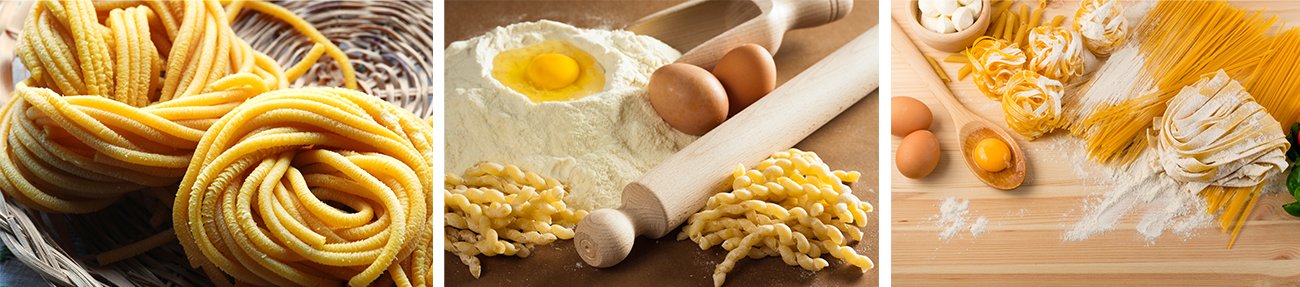
Now we have come to central Italy, between Umbria, Lazio, Marche and partly Romagna, lands of the then Papal State, where Strozzapreti originated.
Why Strozzapreti? “Omen nomen” one would say, or fate in the name that would derive from the fact that this type of pasta, given its shape, not always easy to eat, alludes maliciously to the proverbial gluttony of priests. As we are reminded by the poet Gioachino Belli (1971-1863) who, in one of his celebrated Romanesque sonnets, tells of a gluttonous and greedy priest intent on gobbling without any difficulty even a huge portion of Strozzapreti.
Back to Tuscany, the land of Pappardelle, the origin of whose name apparently comes from the very Tuscan verb pappare.
As Wikipedia reminds us, “This wider version of tagliatelle was eaten in eastern Tuscany as early as the late Middle Ages; it is mentioned later in writings from the 13th century. Boccaccio mentions them in the Decameron (VIII,3) speaking of the Land of Bengodi where they cooked them in capon broth, and then they threw them down, and whoever had the most had the most; and there near ran a fiumicel of vernaccia, and later in the late work Il Corbaccio made with cheese. In Renaissance times they are mentioned by Pier Aretino…”
They are excellent sauces made with game such as Ragout of Wild Boar.
Now a moment of recollection, enter the Spaghetti.
Rivers of ink could be consumed for the king of pasta, the best-known product whose origin goes back a long way. Suffice it to say that they find their origins in the 6th century B.C. in the Indus Valley, a territory located in Western Asia that corresponds in good part to that occupied by present-day Pakistan. In the early days they were a mere waste, produced from the processing of dough, in the royal kitchens of the Sultan of Bahawalpur. The name apparently comes from their shape when dried, which made the Sultan’s son exclaim at the sight of them, “What is this? She stands strutting like my father’s soldiers!” In that region the term sipahee was used to refer to a soldier, and this name was immediately given to that particular type of noodles, the Spaghetti precisely.
But how did they come to our peninsula? The person responsible for this wonderful gift was our beloved Marco Polo. As the Fabianelli Pasta Factory – Pasta Toscana website reminds us, “On his return from Catai, the Italian explorer was hosted by a Turkish merchant, who offered him a local dish with a delicious flavor, spaghetti with shrimp, called spahi in that place. The author of “The Million” was so impressed that he was left with the recipe, and once he returned to Venice he did everything he could to spread it. The original word ‘spahi’ was later changed by the Italian language to ‘spaghi,’ and from there to affectionately calling them ‘spaghetti’ was a short step.”
Finally, a hop to Campania, a land of rich tradition. Here two types of pasta stand out over the others: Maccheroni and Paccheri.
The etymology of the word macaroni is somewhat controversial. For some, the term “macaroni” would derive from the Latin word “maccare,” meaning to crush. For others, the root of the term would originate from “Maccus,” one of the characters of the “Atellane,” a primitive playful and licentious theatrical spectacle that arose at Atella ancient city in Campania. This was an ante-litteram Punchinello, who like him dreamed of nothing but food and was always ready to eat. It may also derive from the Greek word “makar,” as argued by Agnolo Morosini, a philologist who lived in the 15th century, whose meaning is “blissful, happy”-how one feels after eating a good plate of macaroni!
Dulcis in fundo Paccheri. They are a typical pasta in the Neapolitan tradition, shaped like giant macaroni. The term comes again from the ancient Greek (from πας, “all” and χειρ, “hand”) of the founders of Parthènope, ancient Naples. A “pat,” or slap given with an open hand. Hence the name of the type of pasta, much larger in size than normal.
We have finished this short and totally incomplete journey. Many other types of pasta might attract our attention, from Trofiette to Fusilli, from Orecchiette to Penne and many more but for now let us be content and … good pasta to us all! 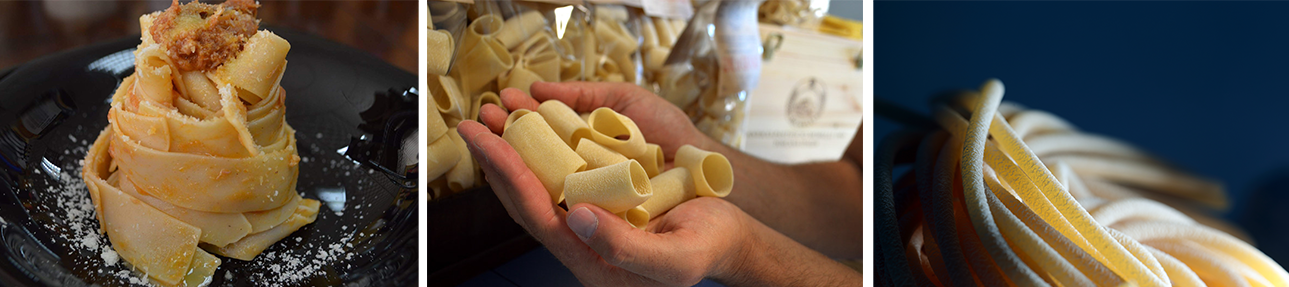
 Artisans
 Catalogue
 Special offers
 About us
 Contacts
 Blog